How to Learn English with AI in 2026: Practical Guide for Speaking Fluency
How to use AI tutors to practice speaking, overcome hesitation, and simulate real-world scenarios. Actionable prompts, study habits, and common traps.

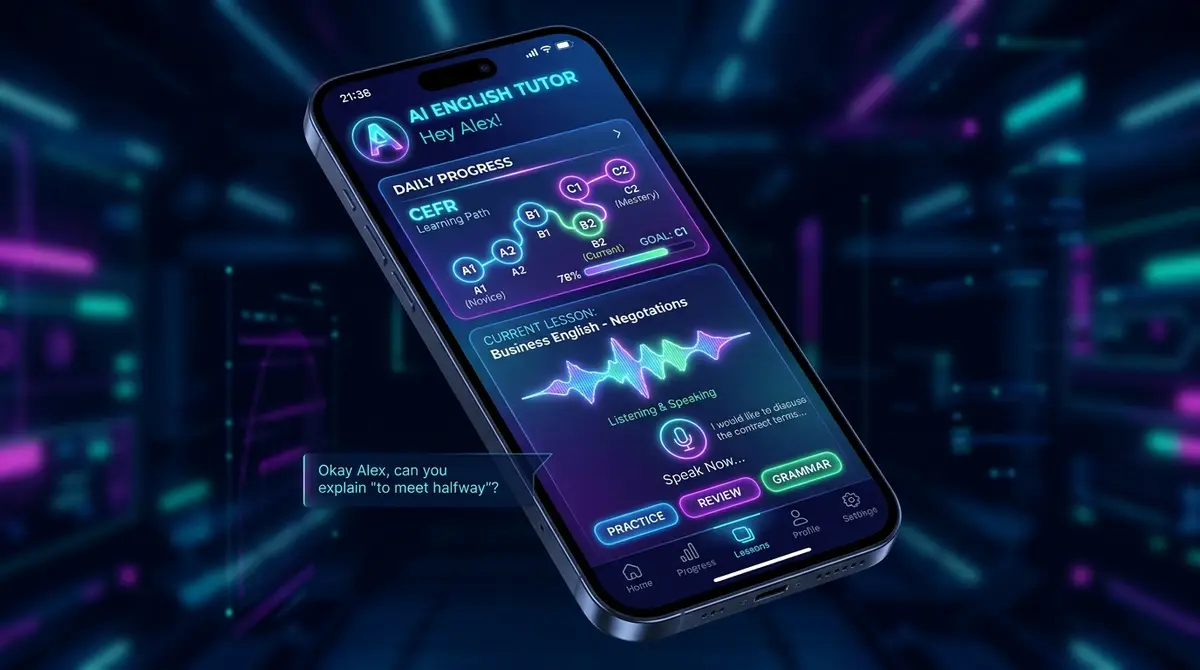
Table of contents
Until recently, learning to speak English required either living in an English-speaking country or paying $30 to $50 per hour for 1-on-1 tutoring sessions twice a week. The problem with weekly lessons is the lack of daily immersion: between sessions, language habits fade, and the fear of making mistakes in front of another person remains.
Modern conversational AI has fundamentally changed language acquisition. An AI tutor is available 24/7, never tires of repeating explanations, and provides a completely private space where you can make 50 mistakes in a row without embarrassment. If speaking anxiety has held you back, our guide on how to overcome the English speaking barrier covers the psychological mechanisms in detail.
Here is how to structure your English practice with AI effectively, avoiding common passive learning traps.
Why Most People Use AI Ineffectively (Text vs Voice)
The most common mistake is using generic text chatbots like ChatGPT purely through typing. When you type in English, your fingers do the work while your vocal cords and speech muscles remain dormant. Reading and writing rely on different cognitive centers than real-time vocal production.
| Format | What It Actually Trains | Impact on Spoken Fluency |
|---|---|---|
| Text Chat | Spelling, grammar rules, delayed retrieval | Low — does not build speech muscle memory |
| Passive Listening | Auditory recognition, comprehension | Moderate — passive recognition only |
| Voice-Based Interactive Role-Play | Real-time speech retrieval, rhythm, pronunciation, active responses | Very High — direct transfer to meetings and interviews |
3 High-Yield AI Prompts for Spoken Practice
If you use general-purpose conversational LLMs, use structured role-play prompts rather than vague open-ended queries:
Prompt 1: The Strict Job Interviewer
"Act as an engineering director conducting a behavioral interview in English for a senior role. Ask me one question at a time using the STAR format. Wait for my vocal answer. Do not give away the answer. After each response, provide brief feedback on clarity and suggest one natural idiom before asking the next question."
Prompt 2: The Fast-Paced Standup Colleague
"Simulate a morning daily standup in a distributed tech startup. You are the Scrum Master. Ask me for my update on yesterday, today, and blockers. Interrupt me with a clarifying question about dependencies, then let me answer."
To prepare your answers for these exact prompts, check our phrase collections for job interviews in English and daily standups.
Common Mistakes When Practicing with AI
AI is a tool, and its effectiveness depends on your boundaries. Avoid these three common traps:
- Trap 1: Letting the AI talk too much. If your AI companion generates 3-paragraph essays while you only say "Yes, I agree", you are consuming, not producing. Instruct the AI to limit its responses to 2 or 3 sentences.
- Trap 2: Chasing academic perfection. Do not obsess over rare idioms or literary words. Focus on core conversational verbs, clear sentence transitions, and natural pacing.
- Trap 3: Irregular binge sessions. Two hours on Saturday followed by six days of silence will not create fluency. 15 focused minutes every morning before work build lasting automaticity.
Daily Practice in the Aloma iPhone App
Prompting generic text chatbots manually can be tedious. That is why we built Aloma: an iOS application designed from the ground up for purposeful spoken English practice.
Aloma offers 1,500+ lessons from A1 to C2 for adults—from sprint meetings and salary talks to airport check-ins and casual team banter. Aloma listens to your spoken English, corrects errors gently, and helps you build natural fluency step by step.
Frequently asked questions
Can an AI tutor completely replace a human English teacher?
AI tutors excel at unlimited, judgement-free spoken repetition, immediate grammar checks, and simulating specific scenarios like interviews or negotiations. While human teachers provide emotional mentoring and certified test assessment, AI is a low-cost way to get daily speaking practice between lessons.
Is text chat with AI effective for improving spoken English?
Text chat improves writing and vocabulary retrieval, but spoken fluency requires speech motor coordination. To overcome conversational hesitation, always prioritize voice-based AI modes with speech recognition and audio playback.
How do I know what CEFR level I should practice at with AI?
Most adult professionals who read English well operate at a B2 passive level but an A2–B1 active spoken level. Setting your practice target to intermediate (B1) ensures comfortable conversational momentum before tackling advanced C1 nuances.
How many minutes per day should I spend practicing with AI?
A focused 15-minute daily session is ideal. It fits into your morning routine or commute, keeps mental fatigue low, and ensures consistent neurological reinforcement.